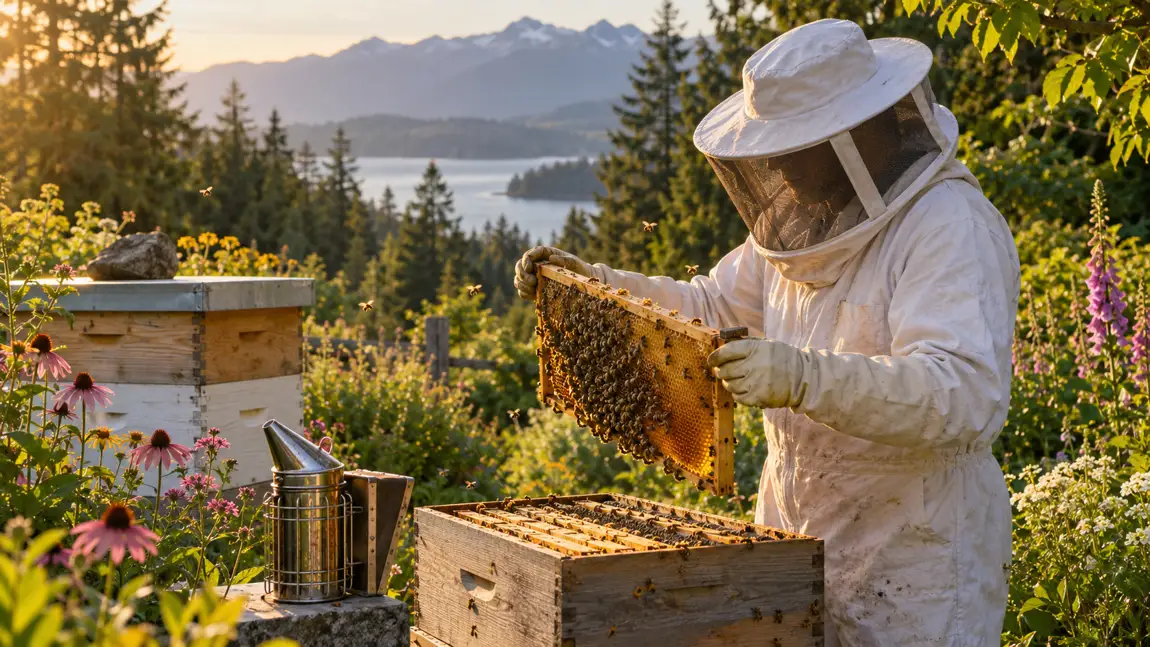
There is an appealing story about beekeepers: spend your days caring for bees, and perhaps the bees give something back in years. It is exactly the kind of idea that makes a hive mind curious. Before turning it into a promise, though, it helps to ask what researchers actually measured.
The evidence discussed here does not establish that beekeepers live longer. An interesting finding about a biological marker is a starting point for questions, rather than a count of extra birthdays.
The small study behind the question
A 2015 Malaysian study compared 30 male beekeepers with 30 male non-beekeepers. Researchers reported significantly longer telomeres in the beekeeper group. They also found associations between telomere length and the duration and frequency of bee-product consumption.[1]
That is a finding about the participants’ telomeres. The reported analysis did not establish their eventual lifespans. It also cannot show that beekeeping or eating bee products caused a longer life. A small, male-only comparison does not establish the same result for everyone.
Why telomeres enter the conversation
Telomeres help protect the ends of chromosomes, and their maintenance is part of aging research. The National Institute on Aging describes how telomere dysfunction relates to cellular processes and disease.[2] That makes them scientifically interesting; it does not turn one measurement into a personal lifespan forecast.
A 2023 systematic review and meta-analysis examined telomere length and age across 414 study samples. It found that methodological factors, including the tissue studied and measurement method, affected the relationship.[3] The wider picture calls for careful interpretation.
Keep three different ideas separate
“Beekeepers had longer telomeres in this study,” “beekeeping caused that difference” and “beekeepers live longer” are different statements. The first describes a reported result. The other two need evidence of their own. It is easy for an attractive headline to slide between them without the reader noticing.
For us, that distinction is part of being curious rather than simply collecting claims that sound good for the brand. The useful next questions include whether a finding is repeated, what else differs between the groups and whether research measures the outcome a headline promises. These are questions to ask of a longevity story, not answers supplied by a greenhouse image.
What this means at Med Bee Tate
Our interest in bees does not depend on selling extra years. Med Bee Tate’s Langley concept brings together a warm greenhouse, group meditation and private rest rooms with a bee-inspired identity. Those are experiences to describe in their own terms.
The beekeeper research does not test an hour in our proposed room, an afternoon rest, an overnight stay or a greenhouse breathwork session. We will not present those visits as telomere treatments or lifespan-extending services. The same separation applies to our planned honey and royal-jelly collection: a product needs its own accurate information.
There is still plenty to enjoy in the idea of slowing down, paying attention and being fascinated by a hive. A memorable place can invite that curiosity without turning it into a biological guarantee.
Hive Minds Want to Know
We will keep asking questions as Med Bee Tate takes shape in Langley, BC. If you enjoy the story behind the buzz, explore the journal and request opening updates through the newsletter section.
Sources and reading
- Mohamad Nasir NF et al. The relationship between telomere length and beekeeping among Malaysians. Age (Dordr). 2015;37:9797. DOI: 10.1007/s11357-015-9797-6.
- National Institute on Aging: Section for Telomere Maintenance.
- Telomere length and chronological age across the human lifespan: a systematic review and meta-analysis of 414 study samples including 743,019 individuals. Ageing Research Reviews. 2023;90:102031.